A quick word on where these came from. PilatesNote exists because, as instructors, we got tired of the gap between sessions: the client walking in while you are still trying to remember which spring you left her on. These templates are the paper version of the system we built for ourselves. We are sharing them free because every instructor deserves a decent way to keep notes, whether or not they ever download our app.
No catch, no email gate. Print them, copy them, hand them to the instructor at the next reformer over.
Both templates are free PDFs, sized for Letter paper. No email required. The links below are the PDFs.
Download the Client Profile Sheet (PDF)
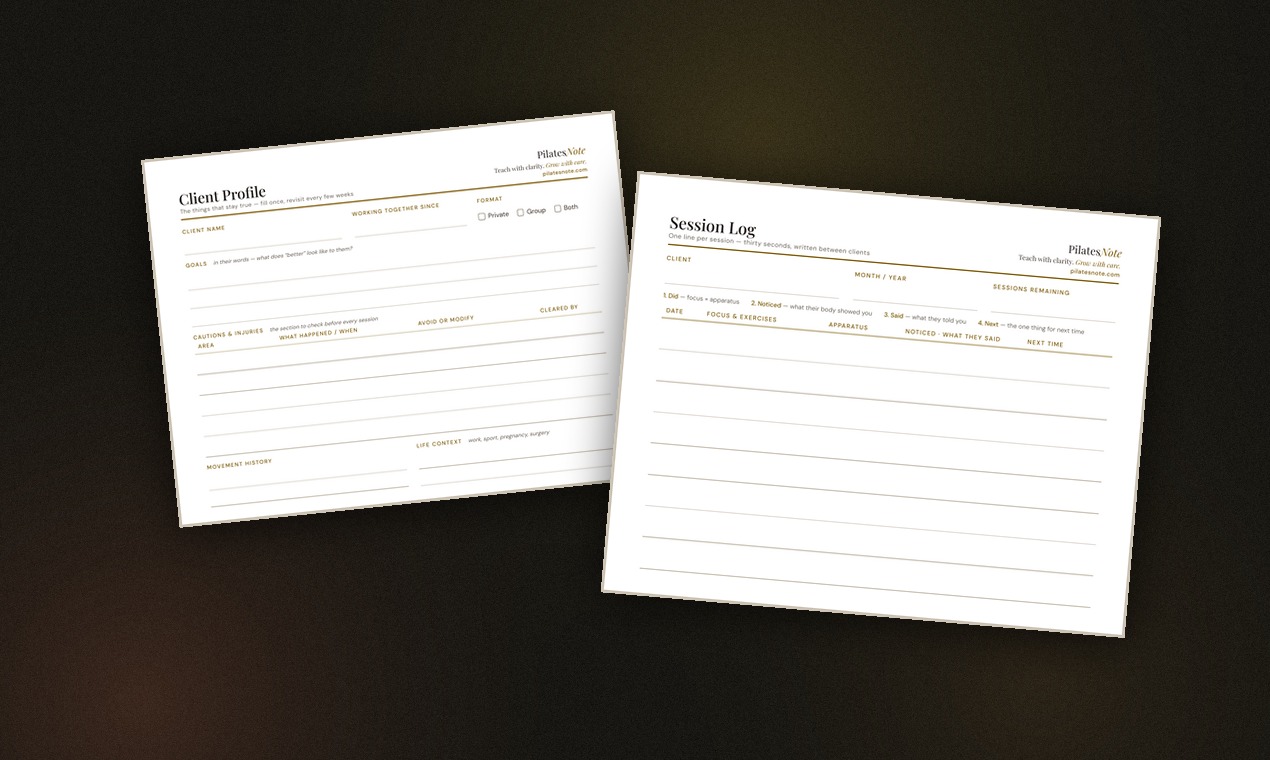
One page per client: goals, cautions, movement history, preferred apparatus.
Download the Session Log Sheet (PDF)
Dated rows for exercises, observations, and next-session priorities.
What is inside each template?
How do you use them together?
The split is deliberate: one sheet for what is stable, one for what changes. The profile sheet gets filled in once, at or just after the first session, and only touched when something real changes: a new goal, a new caution, a switch from group to private. The session log is the working document: one row per session, written in the minute between clients while the details are still warm.
| Aspect | Client Profile Sheet | Session Log Sheet |
|---|---|---|
| Fill it in | Once, after the first session | Every session, one row |
| Read it | Before a session, when something feels off, or when they return after a break | Right before the client walks in |
| Lives | Front of the client's section | Behind it, newest page on top |
If you are building the first-session habit itself, the profile sheet pairs with what to ask before the first session; the questions there produce exactly what this sheet stores.
What should you write in each field?
The templates work if the words in them are the right kind. Three rules keep them useful:
Write what you taught, not just that you taught. “Reformer, felt good” tells you nothing in six weeks. “Footwork 2R+1B, bridging full articulation, short spine first try” is a row you can teach from.
Record observations and cues, never diagnoses. “Cue lateral breathing earlier” and “watch left hip in side kicks” are teaching instructions, and that is your lane. Clinical-sounding labels are not, and they do not help you plan a session anyway.
Always fill the next-session column. It is the highest-value field on the page. A log with a plan column is a planning tool; without it, it is a diary. For the full method behind these rules, see how to keep client notes as a Pilates instructor; these two PDFs come from that guide.
How should you print and store them?
Print the profile sheet single-sided, one per client. Print session logs in batches; a month of sessions fits comfortably on a page, so a client you see weekly needs about a page a quarter. A single binder with a tab per client beats separate folders: everything travels to the studio together, and pulling a client's history means opening one thing. Keep it somewhere private; these are client records, even on paper.
When do you outgrow paper?
Paper templates are a real system, not a stopgap; plenty of instructors run their whole book on a binder like this. The limits show up at scale: around fifteen or twenty clients, the binder still holds the notes but stops answering questions. When did I last progress her springs? Which clients have not booked in three weeks? What did I plan for tonight's group class? Flipping pages answers those slowly; an app answers them instantly, and backs everything up. If your format is drifting toward more clients and more classes, that trade-off is worth a look. Group class vs. private sessions covers how format changes what you need to track.
One last thing, instructor to instructor. These sheets are exactly how we kept notes for years, and they work. But we eventually built PilatesNote because the binder kept failing us at the worst moments: the client who books a last-minute slot when the binder is at home, the goal you wrote down in January that you cannot find in June. So we put the same profile, the same log, and the same next-session column into an app that lives on your phone. Every note and everything you know about each client, ready before they walk in.
That knowledge is what a teaching practice runs on. Clients who feel remembered stay engaged, clients who see their progress stay satisfied, and clients who stay are how your book grows. The app is free, like the templates. If the paper system clicks for you, PilatesNote is the same system with a search bar and a backup.
The same system, without the binder.
PilatesNote keeps client profiles, session logs, and next-session plans on your phone: searchable, backed up, and ready before every session.
Download PilatesNote free on the App Store →Frequently asked questions
Are the templates really free?
Yes. Direct PDF downloads, no email, no signup. Print as many copies as you need for your own teaching.
Do they work for group classes?
The profile sheet does, as-is. For the log, keep one sheet per class instead of per client: note the class plan in the exercises column and use the observations column for the two or three clients you watched closely that day.
Can I use them on an iPad instead of printing?
Yes. They are standard PDFs, so they work in GoodNotes, Notability, or any PDF annotation app. Duplicate the page per client or per month.
What paper size are they?
US Letter. They print fine on A4 with fit to page; the margins are generous enough to survive the scaling.