There are only two moments that matter. When a client joins, capture four things: their level, what they are working toward, anything to be careful with, and what works well for them. Then as they progress, add a one-line note whenever something happens worth remembering. The first takes a minute. The second takes seconds. Together they are the difference between a client being taught and a client being known.
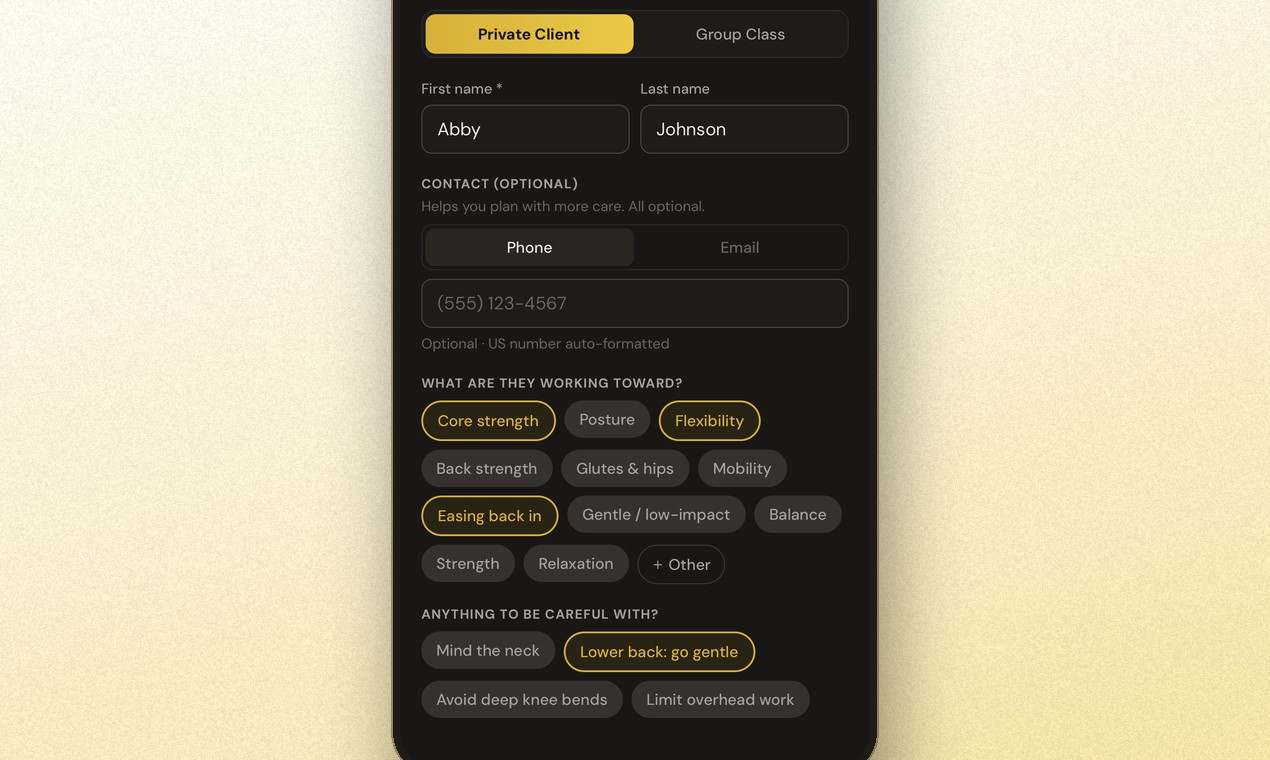
If you already keep session notes using did, noticed, next and said, you have the harder habit in place. This is the layer underneath it, and it is much less work.
The reason to separate the two is practical. Most instructors who give up on note-taking do so because their notes got long: every session they re-wrote the knee history, the goal, the preferences. Split the record in two and that stops. Standing information sits in one place and never competes for space with today’s observations again.
Why isn’t a good session note enough?
Because a session note is a snapshot, and the most useful things about a client never show up in any single one.
Read back last Tuesday’s note and see what you cannot learn from it. Whether this person has been practising for six weeks or six years. Whether they want to be told or shown. Whether the goal they arrived with still means anything to them. Whether their wrists need you to plan around them. None of that belongs in a session log, and all of it changes what you teach.
The other problem is retrieval. Scanning back through fifteen session notes to reconstruct someone’s history is exactly the friction that makes instructors stop looking. A profile is one screen you can read while they are taking their shoes off.
What should you capture when a client joins?
Four things do almost all the work. Resist the urge to build anything more elaborate on day one, because a record you can fill in during the first conversation is a record that actually gets filled in.
1. What is their level?
Not a grading, just a rough placement: new to Pilates, some experience, or a consistent practitioner. It sounds almost too simple to bother with, and it is the field that changes your planning most.
Two clients can want exactly the same thing and need completely different routes to it. Someone new to Pilates wanting core strength needs the fundamentals taught properly and slowly. A consistent practitioner wanting core strength is bored by that and needs load, complexity or tempo. Same goal, different session entirely.
2. What are they working toward?
Ask it in those words rather than asking for goals. People deflect when asked for a goal, because it sounds like they are supposed to have an impressive one. Ask what they are working toward and you get the real answer.
The combination is where the useful information sits. Core strength on its own tells you little. Core strength plus easing back in tells you to build carefully and celebrate small wins. Core strength plus loves a challenge tells you the opposite.
One thing worth doing at the same time: note that you asked. Goals go stale silently. Someone arrives wanting to be pain-free, gets there in four months, and trains for another two years against a goal nobody has mentioned since. They are not dissatisfied exactly, but nothing is being aimed at.
3. Anything to be careful with?
This is the field with the most value and the most potential to be written badly. The rule that keeps it useful and keeps you inside your scope is simple: record the instruction, not the diagnosis.
Look at the difference between those two ways of writing the same thing. “Lower back: go gentle” tells you what to do at the moment you need to know it. A condition name does not, and it also commits you to an interpretation that may not be yours to make.
Where a client has told you something specific from a healthcare practitioner, write it as what you were told and who told them. “Says her physio wants no loaded spinal flexion for now” is accurate, actionable, and honestly attributed. It protects the client, it protects you, and it is simply truer than the alternative.
4. What works well for them?
The most underrated of the four, and the one instructors most often keep only in their heads.
Some people want to be corrected constantly and read silence as boredom. Some need to understand why before they will commit to a movement. Some go quiet and slow when they are concentrating, and reading that as struggle makes you intervene when you should wait.
Two taps here make you feel remarkably attentive six months later, and they are the single best defence against the sensation clients describe as being taught a class rather than being taught.
And a free space for everything else
Keep one open field for the things no list will ever anticipate. Useful candidates: equipment setup they always need, in whatever notation your own kit uses. Their schedule pattern and when they predictably disappear. How they came to you. Whether they are happy with hands-on adjustment or would rather you ask first, which is worth writing down explicitly and treating as revocable rather than settled forever.
What to leave out is just as important. If it would not change what you plan or how you teach, it does not belong in a file about someone’s body. Relationship details, money worries, studio gossip: none of it earns its place.
Why does tapping beat typing here?
This sounds like a small point about tools. It is actually the whole reason profiles get built or abandoned.
A blank text box asks you two questions at once: what do I write, and how do I say it. That is why instructors sit in front of an empty notes app and write nothing, or write a paragraph so long they never do it again. A list of options asks only one question: which of these is true. You can answer it in the four seconds while someone is putting their socks on.
There is a second effect that matters more. A fixed set of options makes your records comparable. When every client’s careful-with field is written in the same vocabulary, you can look across your whole roster and see patterns: how many people you have who need wrist alternatives, how many are easing back in this month. Free text never gives you that, because you wrote it eleven different ways.
The trade is expressiveness, which is what the free field is for. Structure for the things that repeat, open text for the things that do not.
What should you add as a client progresses?
The setup is a snapshot of who someone is on day one. People change, and the record has to keep up without becoming a second job.
The way to do that is short, categorised notes: one line, tagged with what kind of thing it is, added the moment it happens. Six categories cover nearly everything worth capturing.
| Category | What belongs here | Example |
|---|---|---|
| Milestone | Something that was not possible before | First full teaser unassisted |
| Progress | Movement quality improving, even without a headline moment | Hips finally staying level in short spine |
| Challenge | A setback, a flare-up, a plateau, something that got harder | Wrists bothering her again after a week at a desk |
| Goals | What they are working toward has changed or been reviewed | Wants to add balance work before ski season |
| Enjoys | What lands, what they ask for, what visibly lifts them | Asks for the chair every time now |
| Avoid | Something to stop doing, whether physical or preference | Hates being counted down, says it rushes her |
Categories matter more than they look. They are what let you pull up only the milestones for a client who thinks they are stuck, or only the challenges before a session where you want to be careful.
The discipline is one line, written at the time. Not a summary at the end of the week, when the specifics have gone and you are reconstructing rather than remembering.
What actually counts as a milestone?
Two different kinds, and instructors tend to only notice the first.
The ones the client feels. A movement they could not do before. A change they noticed outside the studio, like carrying shopping upstairs without stopping, which is often more meaningful to them than anything that happened on the reformer. And requests: a client asking to try something harder is telling you where they think they are, which is progress worth recording.
The ones that just accumulate. Session counts. Someone reaching their fifth or tenth or fiftieth session is a real moment, and it is completely invisible unless something is counting for you. These are the easiest wins in client relationships, because acknowledging them costs one sentence and lands as genuine attention.
Both are worth keeping for the same reason: they are your evidence at the exact moment a client says they feel stuck. Most people quietly decide whether to continue somewhere around the point where progress stops being obvious to them. Being able to say what has changed since they started, specifically, is the most useful thing you can do at that moment.
How often should each part be updated?
Different parts move at different speeds, which is why “keep your records up to date” is useless as advice. Give each one its own rhythm instead.
| What | Update when | Realistic cadence |
|---|---|---|
| Be careful with | They mention any change, or see a practitioner | Same day, every time |
| Working toward | You have an actual conversation about it | Every 8 to 12 weeks |
| Level | They have genuinely moved up | Once or twice, ever |
| What works well | You notice a pattern in what lands | First month, then rarely |
| Quick notes | Anything happens worth remembering | As it happens |
| Free notes | Setup, schedule or preferences change | A few times a year |
Only the first row needs same-day discipline. Everything else tolerates being a bit behind.
How do you know the record is good enough?
Use the handover test. Imagine you woke up unwell and a colleague had to teach this client tomorrow morning, with no chance to call you.
Could they, from the record alone, pitch the session at the right level, know what the person is working toward, avoid the thing that must be avoided, and cue in the way this client responds to?
If yes, you are done. If no, the gap you just noticed is the field to fill. It is faster than any checklist, and it has an obvious real-world payoff: at some point you will be ill, or away, or handing a client on, and this is what makes that graceful instead of apologetic.
All of this, in taps.
PilatesNote is a free iPhone app for instructors. Set up a client in about a minute, add quick notes in seconds, and see who is coming up on a milestone.
Free on the App Store.
Download PilatesNote free →